top of page


How can design make complex systems feel deeply human?
That question has led me from entrepreneurship to branding, from community development to service design, organizational systems, and now to product.
Every chapter taught me a different way to design for people.
This is that story.
Only have a few minutes?
Start with my featured case studies →


The first experience I ever designed wasn’t digital. It was a nail appointment!
At fifteen, I wasn't looking for a career in beauty. I was looking for a way to build something of my own. Long before I understood design thinking, I was already asking questions that would shape the rest of my career.
Why do people choose one experience over another?
Every client became research. Every appointment became a prototype. Every returning customer became validation that thoughtful experiences create loyalty.
I was learning how trust is built, how relationships are formed, and how small details shape the way people feel.
Looking back, I wasn't designing manicures. I was designing experiences.

Before SCAD, I learned to build businesses, earn trust, and create experiences people wanted to return to.
What I didn't have was the language to explain why those experiences worked.


At SCAD, I discovered design thinking, research, storytelling, systems thinking, and strategy. For the first time, I could connect instinct with intention and creativity with business.

Identity + Social Impact
SCAD is where
I put a familiar face to a name and I began designing with intention.


Until then, my work centered around building my own business. At SCAD, I discovered that the same thinking could solve problems for brands, nonprofits, entrepreneurs, and entire communities.
Package Design for
Personal Identity
Using design to communicate who we are.
Fundraising Campaign for Social Impact
Using storytelling to create economic opportunity.
A few proud moments
Along the way


The Every Door Project
After working with Ghanaian weavers through the T.I.E. Initiative, I saw something I couldn't unsee. Storytelling didn't just raise awareness. It created economic opportunity.
By helping investors connect emotionally with the people behind the products, we changed the conversation from funding a craft to investing in a community.
That made me wonder: If storytelling could create opportunity halfway across the world, could it do the same for communities closer to home?
Growing up in Detroit, I watched neighborhoods struggle through economic decline after the 2008 recession.
My grandfather purchased a home in Washington, D.C. for just $24,000 in the 1940s. Decades later, it was worth millions, yet that generational wealth never reached my family because of a reverse mortgage.
Years later, I experienced another version of displacement firsthand when I lost my own salon to unsustainable rent increases, just blocks from Atlanta's historic Sweet Auburn district.
These stories revealed a pattern: Communities were losing not only buildings and businesses, but the stories, relationships, and opportunities that made those places meaningful.
That became the foundation for The Every Door Project.
Could storytelling become a system for preserving culture, strengthening local economies, and creating new pathways for community investment?
Explore my graduate thesis:
The EveryDoor Project →
My thesis explored how storytelling could preserve communities.
SPARK gave me the opportunity to actually test those ideas.
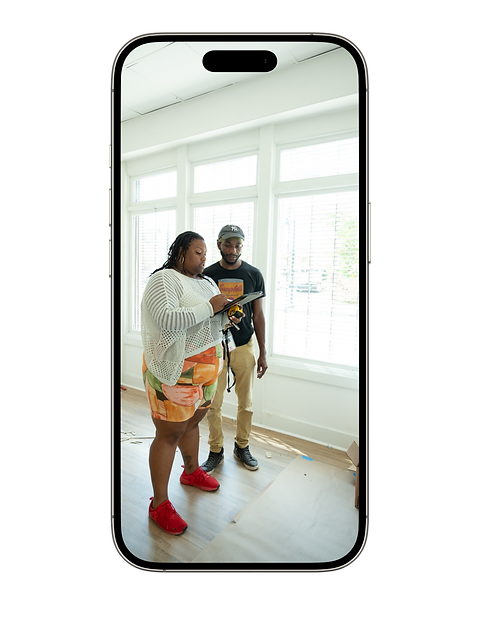
A public art experience inspired by
The Every Door Project.
Watch the installation →
View the concept deck →
I moved beyond designing stories to designing systems. Instead of simply communicating ideas, I built an entrepreneur support ecosystem that transformed research into measurable community impact.

Process Design for Economic Develoment
Helping entrepreneurs launch, grow, and sustain.
What started as a graduate thesis became a multi-year role leading strategy, partnerships, operations, and program design for entrepreneurs in Atlanta's historic Sweet Auburn district.
Design Recognition
Sweet Auburn Bread Co.


Systems Design for
Health Equity
Transforming operations into better human experiences.
SPARK taught me how to design processes that helped small businesses thrive.
Morehouse School of Medicine challenged me to do the same thing inside a complex academic medical institution.


Every chapter expanded both the scale of the problems I solved and the number of people those solutions could reach.
I've learned that good design isn't defined by the medium.
Whether I'm designing an appointment, a brand, a community initiative, an operational system, or a digital product, my work has always been about the same thing:
Helping people navigate complexity with confidence.
I'm still learning. Still asking better questions. Still following my curiosity.
I'm excited to keep designing for people and solving bigger problems!
Talk soon,
Dayna
bottom of page